

-

Our location is in the heart of London
-

Top 5 in London for Psychology (Complete University Guide 2023)
-
3
rd in London for student satisfaction
About
We are a thriving, research intensive department, conducting world class research across many areas of psychology including autism, memory, decision making and cognitive neuroscience.
Students learn from active researchers and expert practitioners in range of innovative degree programmes.
Investment in recruiting researchers with established, recognised expertise over recent years has allowed the department to expand substantially, fostering a dynamic environment for research and learning.
Excellence in teaching
Our academics and staff members are often recognised by their excellent teaching. For example, Dr Stian Reimers and Dr Jessica Jones Nielsen have won the Vice-Chancellor’s Award in the category of Excellence in Learning and Teaching.
Professor James Hampton was awarded the Research Supervisor of the Year and Dr Andreas Kappes won the Teaching Excellence Award! at the Academic Impact Awards run by the Student's Union and the Learning Enhancement and Development (LEaD).
What is it like to study Psychology at City?
Our Research Students organise national events such as Brain Awareness Week, Pint of Science and Heroes of Neurons. These events are celebrated every year at City, University of London.
City teaching and research programmes have unique features to enhance your experience at City.
City was one of the first institutions to develop DPsych programmes in Counselling Psychology.
Our BSc Psychology degree we provide the opportunity for you to graduate with a BPS accredited BSc Psychology degree in a specialised area of Psychology (4 pathways here - Counselling and Health Psychology, Organisational Psychology and Behavioural Economics, Psychology with Cognitive and Clinical Neuroscience and Psychology with Child Development).
Our MSc programmes offers clinical internships in clinical settings such as Mind (Hackney) and we have developed international PhD programmes to provide our students with research experience in international laboratories.
Study
Staff
Featured academics

Academic staff
- Dr Carsten Allefeld, Lecturer in Psychology
- Professor Peter Ayton, Visiting Lecturer
- Professor Dermot Bowler, Professor of Psychology
- Professor Beatriz Calvo Merino, Professor in Cognitive Neuroscience
- Dr Julianna Challenor, Senior Lecturer
- Dr Sara Chaudry, Lecturer in Counselling Psychology
- Dr Julia Christensen, Newton International Research Fellow
- Dr Seraphine Clarke, Senior Lecturer
- Paula Corcoran, Senior Lecturer in Health Psychology
- Professor Philip Corr, Emeritus Professor of Psychology
- Dr Dean D'Souza, Lecturer in Developmental Psychology (Research and Education)
- Dr Helen Damon, Senior Lecturer in Counselling Psychology
- Dr Danai Dima, Professor
- Dr Katrina Dulay, Lecturer in Developmental Psychology (Research and Education)
- Dr Kathryn Emerson, Lectureship in Psychology
- Dr Ansgar Endress, Senior Lecturer in Psychology
- Dr Anne-Kathrin Fett, Reader
- Paul Flaxman, Reader
- Professor Bettina Forster, Professor in Cognitive Neuroscience
- Dr Elliot Freeman, Reader
- Professor Sebastian Gaigg, Head of Psychology
- Dr Lucia Garrido, Senior Lecturer
- Dr Martina Gerada, Lecturer in Counselling Psychology
- Jennifer Gerson, Lecturer in Organisational Psychology
- Dr Ava Green, Lecturer in Forensic Psychology
- Dr Cerisse Gunasinghe, Lecturer in Counselling Psychology (Education)
- Alice Haddon, Lectureship in Councelling Psychology
- Dr Corinna Haenschel, Professor
- Professor James Hampton, Honorary Research Fellow
- Professor Mark Howe, Professor of Psychology
- Dr Vasanti Jadva, Reader in Psychology
- Dr Andreas Jarvstad, Senior Lecturer
- Dr Jessica Jones Nielsen, Assistant Vice President (EDI- Race Equality)
- Dr Daphne Josselin, Lecturer in Counselling Psychology
- Dr Holly Kahya, Lecturer in Counselling Psychology
- Dr Andreas Kappes, Senior Lecturer in Psychology
- Dr Mehdi Keramati, Lecturer in Psychology
- Dr Lauren Knott, Reader
- Anna Lambrechts, Lecturer in Psychology
- Dr Sophie Lind, Reader in Psychology
- Dr Lucia Macchia, Lecturer in Psychology (Education and Research)
- Dr Ohemaa Nkansa-Dwamena, Associate Professor
- Dr Aylish O'Driscoll, Senior Lecturer in Counselling Psychology
- Dr Dimitrios Pinotsis, Reader
- Dr Anke Plagnol, Senior Lecturer in Behavioural Economics
- Dr Marie Poirier, Reader
- Professor Emmanuel Pothos, Professor of Psychology
- Dr Courtney Raspin, Visiting Lecturer
- Dr Stian Reimers, Professor
- Dr Francesco Rigoli, Reader
- Dr Steven Samuel, Lecturer in Psychology
- Dr Fran Smith, Lecturer in Counselling Psychology
- Claire Stone, Visiting Lecturer
- Dr Lydia Tan, Lecturer
- Professor Katy Tapper, Professor in Psychology
- Dr Jutta Tobias Mortlock, Reader in Organisational Psychology
- Professor Carla Willig, Professor of Psychology
- Dr Kielan Yarrow, Reader in Psychology
- Dr Julia Yates, Deputy Head of Psychology
- Dr James Yearsley, Senior Lectureship in Psychology
- Dr Lara Zibarras, Reader
Research
The Psychology Department has a mission to generate world-leading research on mind, brain and behaviour that brings lasting benefits to society. We provide a supporting, vibrant research environment, and have internationally recognised expertise across many sub-fields of psychology.
At the last major assessment of UK research (the Research Excellence Framework (REF) 2014) we ranked 29 out of 82 relevant departments according to the research power measure (which is based on both research quality and research volume).
We use groupings to organise our researchers and promote collaboration and grant capture. We distinguish between groups/units, operating largely within the Department, and centres, which, while based in the Department, are established with specific (often cross-disciplinary) strategic goals and thus incorporate staff from across the institution.
Department of Psychology's research areas
Interdisciplinary centres hosted by the department
Professional Doctorate in Health Psychology training
The Professional Doctorate in Health Psychology training is dependent on trainees finding opportunities to work in placements that allow them to practice their skills.
We aim to establish a good working relationship to ensure that both the workplace and the trainee get the most out of this training. We have developed an online training tool which provides some useful information about the Professional Doctorate in Health Psychology training and work placement.
Download training tool.
Research participation
The Psychology Department at City is a research active department. You can get involved and help with our research by volunteering to participate.
All of our research studies have received ethical approval meaning that they fulfil certain criteria and will not harm anyone in any way.
Some studies pay for participation, some studies are run by our research students as part of their research training.
City Open Days

Register for an Open day, look around our campuses and speak with our staff and students to answer any questions you may have.
News
-
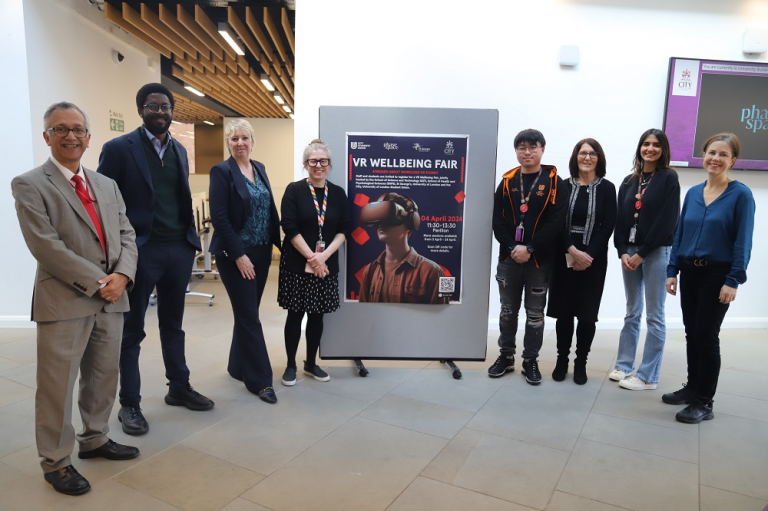
Launch of the VR Wellbeing Fair with Phase Space
Jointly hosted by City’s School of Science & Technology, School of Health & Psychological Sciences, St George’s, University of London and our Student’s Union.
-

Celebrating neurodiversity week
Event was well attended by staff, students and external experts, and it gave participants an excellent opportunity to share their knowledge
-
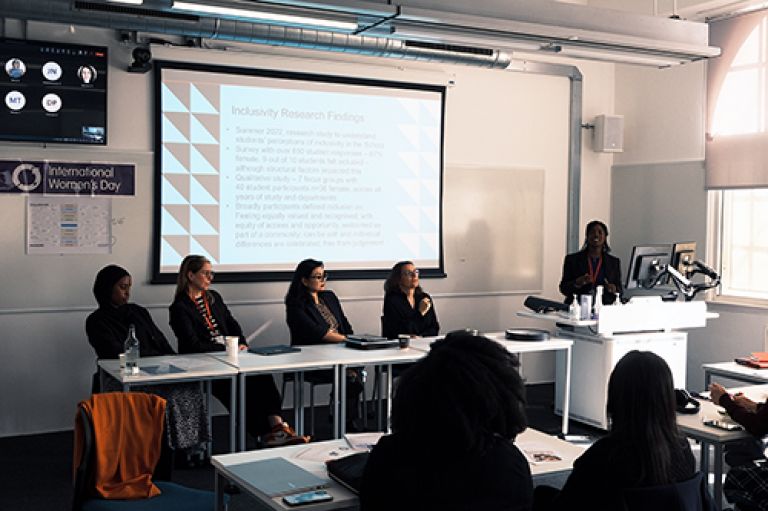
Marking International Women’s Day
School of Health & Psychological Sciences marks International Women’s Day with a special event


Events
Contact us
Find us
-

Northampton Square
City, University of London
Northampton Square
London EC1V 0HB
United Kingdom